Publishing Adapter
Publishing an adapter is the step where a fine-tuning result is promoted from an experimental artifact into a deployable asset. In Protean AI, adapters can only be published from internal fine-tuning runs. This ensures that every published adapter is fully traceable, reproducible, and governed from data to deployment.
Publishing an adapter converts a selected evaluation checkpoint into a format suitable for inference and deployment. The platform handles this conversion automatically. Training-only artifacts are removed, compatibility with the base model is guaranteed, and the resulting adapter is frozen as an immutable release. No manual export or transformation steps are required. Once published, the adapter is immediately ready to be attached to its base model and used in deployment.
See the screenshot below for an example of Publish Model Adapter Configuration.
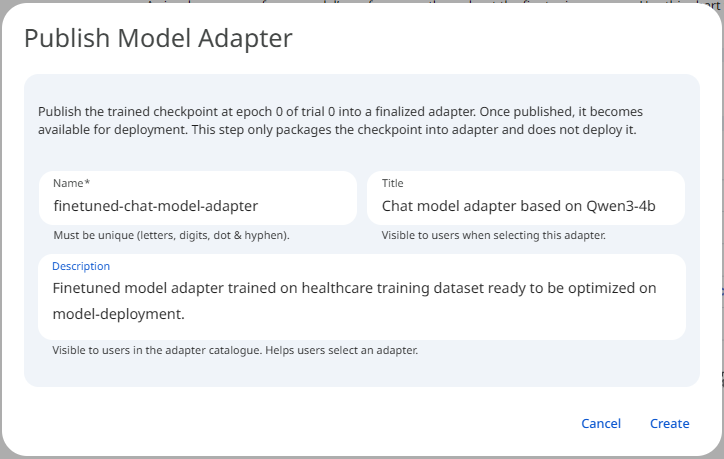 Snapshot of Protean AI Platform
It is possible to upload a custom adapter to the adapter registry by uploading an archive file containing the adapter in Hugging Face format. However, this does not allow Protean AI to track the lineage of the adapter.
Publication
Adapters are published from the evaluation stage of a fine-tune run. Each evaluation represents a validated snapshot of learned behavior and serves as a candidate for promotion. Descriptive metadata such as title and description can be updated without affecting the adapter's operational or scientific integrity.
Name
During publishing, the adapter is assigned a unique name and optional descriptive metadata. The adapter is permanently linked to the base model used during fine-tuning, ensuring architectural compatibility at deployment time. After publishing, the adapter appears in the Adapter Registry as a first-class artifact. From this point on, it can be discovered, reviewed, compared, and deployed like any other production asset.
Model
The Model field specifies the base model on which the adapter was fine-tuned. The adapter can be deployed exclusively together with this base model. The Model field is read-only.
Title
The title provides a short, human-readable identifier for the adapter. It is intended for quick recognition in catalog views and comparison workflows.
Description
The description provides a detailed explanation of the adapter's behavior and intended use. It should clearly state what the adapter was trained to do, describe the nature of the training data, outline the intended deployment scenarios, and highlight any known limitations or constraints. A clear description helps teams select the correct adapter and avoid misuse.
Lineage and Traceability
Every published adapter maintains full lineage back to its origin. This includes the fine-tuning configuration, training datasets and revisions, trials, and the specific evaluation used for publishing. Lineage is immutable and automatically maintained by the platform. It provides a clear explanation of why an adapter behaves the way it does and allows teams to compare outcomes across multiple fine-tuning attempts without ambiguity.
Access Control
Access Control in Protean AI governs who can view, create, modify, and operate resources across the platform. It is designed for enterprise environments where security, isolation, and governance are mandatory. Protean AI follows a principle of least privilege, ensuring users and systems are granted only the permissions required to perform their tasks. When an adapter is published, all permissions from the fine-tune are copied into the adapter's access control configuration. This preserves governance boundaries between teams and environments, ensuring that access granted during experimentation does not change unexpectedly when the adapter becomes production-ready. Permissions can be managed independently after publishing, but no manual setup is required at publish time.
Result
Publishing an adapter creates a clean boundary between experimentation and production. Fine-tuning remains iterative and flexible, while published adapters represent controlled, traceable, and deployable intelligence. This separation allows teams to move quickly during development without compromising safety, auditability, or operational confidence. Adapters are where learning becomes usable.